

Table Of Content
- How to Dress for Your Body Type and Undertone: Start With Proportion
- How to Dress for Your Body Type and Undertone With Better Silhouettes
- Your Undertone Is Not the Same as Your Skin Tone
- Three At-Home Ways to Find Your Undertone
- The vein test
- The jewellery test
- The white paper test
- The Colours That Make Your Wardrobe Work Harder
- Compare the Look Before You Buy
- Your No-Stylist Shopping Checklist
- Frequently Asked Questions
- Do I need to know my body shape to dress well?
- Can I wear colours outside my undertone palette?
- Can Indian skin tones have cool undertones?
- Does virtual try-on tell me whether an item will fit?
You know the feeling: an outfit looks flawless on an Instagram creator, then somehow falls flat when it arrives at your door. Learning how to dress for your body type and undertone makes online shopping less of a gamble—but it should never mean squeezing yourself into a restrictive “pear,” “apple,” or “hourglass” label.
The useful part of personal style comes down to two things: understanding how clothes shift proportions visually, and recognising which colours make your complexion look brighter, richer, or more balanced. Treat both as starting points, not rules. The best outfit is still the one that feels like you.
How to Dress for Your Body Type and Undertone: Start With Proportion
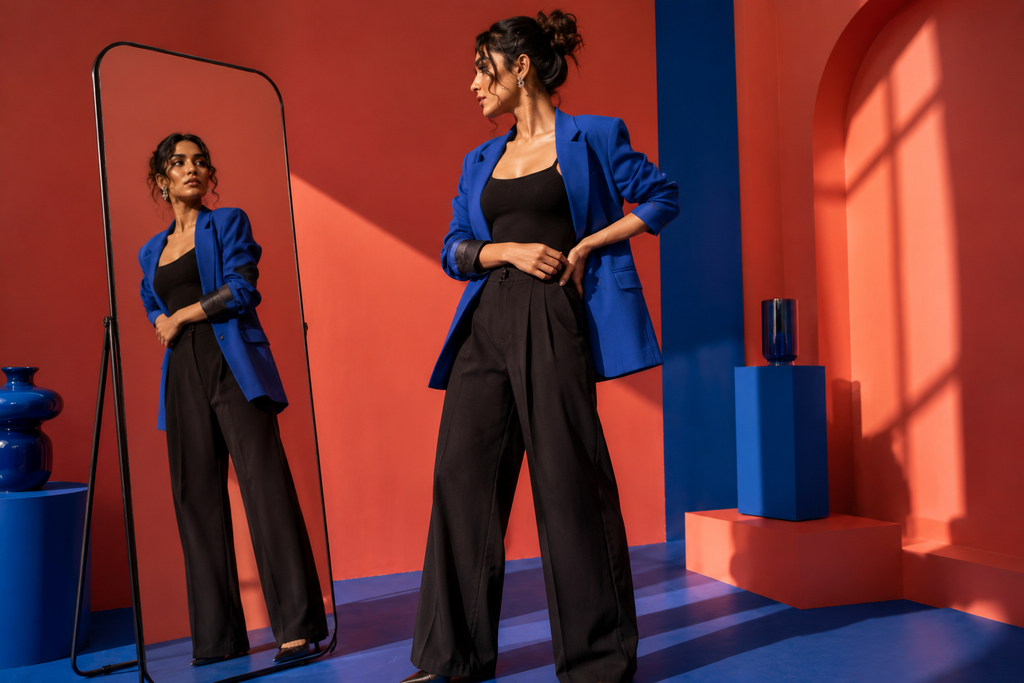
Classic body-shape categories can provide a helpful vocabulary, as Stitch Fix’s guide to body shapes explains. But most people do not fit neatly into one category—and there is no need to try.
Instead, notice your shoulder-to-hip ratio, waist definition, and where an outfit places visual weight. Stand in front of a mirror in fitted basics and consider:
- Do my shoulders look broader, narrower, or similar in width to my hips?
- Is my waist naturally defined, subtle, or somewhere in between?
- Do I want attention on my shoulders, waist, legs, or a longer overall line?
If your hips carry more visual weight than your shoulders, a structured blazer, puff sleeves, a brighter top, or an interesting neckline may create balance. If your shoulders feel more prominent, relaxed trousers, A-line skirts, or layered lower halves can shift attention downward.
Want to highlight your natural waist? Try a belt, fitted kurta, wrap dress, high-rise bottoms, or a saree drape that defines the middle. There is no “correct” proportion here. Clothes simply influence what the eye notices first.
How to Dress for Your Body Type and Undertone With Better Silhouettes
Silhouette is one of the quickest ways to change an outfit’s feel, especially in photos. The aim is not to make everything fitted or everything oversized; it is to create contrast with intention.
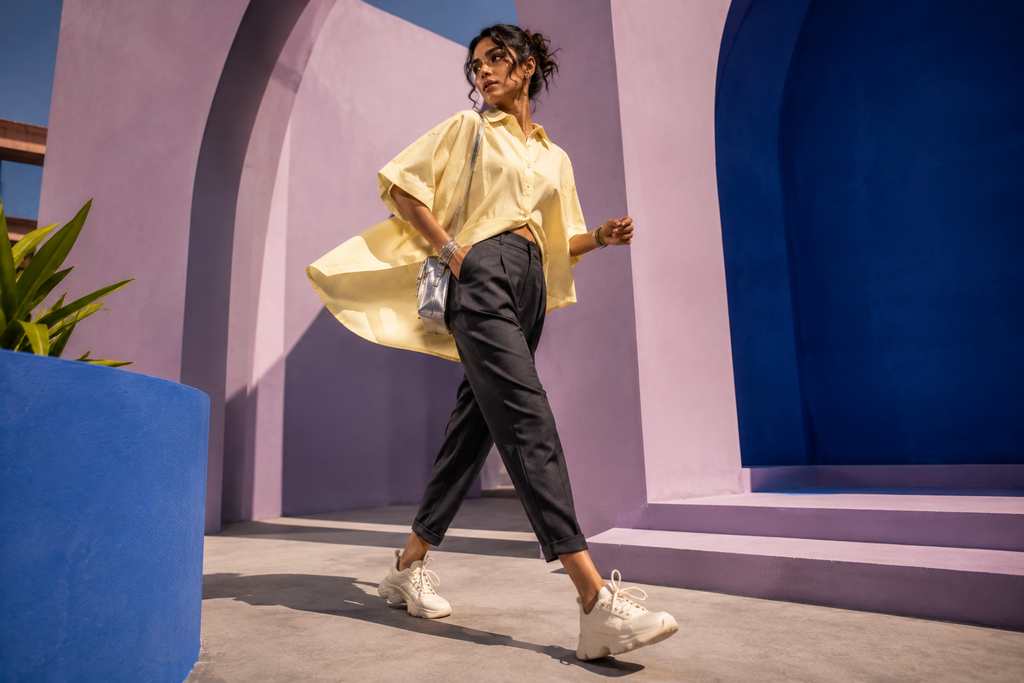
- Oversized top, tailored bottom: Pair an oversized graphic tee or shirt with straight jeans, cycling shorts, or tapered trousers.
- Fitted top, relaxed bottom: A ribbed top with wide-leg cargos, palazzos, or loose denim creates an easy, current shape.
- Cropped layers: Cropped jackets and tops visually raise the waistline and can make legs appear longer.
- Clean vertical lines: Straight-cut kurtas, shirt dresses, column silhouettes, and straight trousers create a streamlined effect.
- Waist definition: Belts, wrap details, peplum cuts, tucked-in shirts, and high-rise bottoms bring focus to the waist when you want it.
Fabric changes the result. A structured oversized shirt holds its shape, while a fluid oversized kurta drapes closer to the body. Neither is better; they simply create different lines.
Oversized clothing does not automatically make you look bigger. Showing a little definition at the wrist, ankle, neckline, or waist—and balancing volume elsewhere—can make a relaxed look feel polished.
Your Undertone Is Not the Same as Your Skin Tone
Your skin tone is the surface colour you see: fair, medium, wheatish, dusky, deep, and everything in between. It can shift with sun exposure, lighting, skincare, and makeup.
Your undertone is the subtle colour beneath that surface: warm, cool, neutral, or olive. It is generally more consistent. As the Cleveland Clinic explains, undertone is a visual characteristic, not a medical diagnosis—and it is not determined by how light or deep your skin is.
This distinction matters in Indian fashion. “Wheatish” and “dusky” are often treated as colour categories, but a deep complexion can have cool, blue-based undertones, while a fair complexion can be strongly warm and golden.
- Warm: Golden, yellow, peach, or golden-red hints
- Cool: Pink, rosy, red, or blue hints
- Neutral: A relatively balanced mix of warm and cool
- Olive: Yellow warmth mixed with green, grey, or muted coolness
Three At-Home Ways to Find Your Undertone
Try these checks near a window in daylight, without foundation or heavy makeup. Do not rely on one test alone: indoor bulbs, tanning, camera filters, and phone processing can all distort colour.
The vein test
- Blue or purple-looking veins may suggest cool undertones.
- Green-looking veins may suggest warm or olive undertones.
- A blue-green mix can point to neutral.
The jewellery test
- If gold makes your skin look lively and even, you may lean warm.
- If silver looks especially crisp and flattering, you may lean cool.
- If both work well, you may be neutral.
- If very yellow gold and icy silver both feel harsh, explore olive.
The white paper test
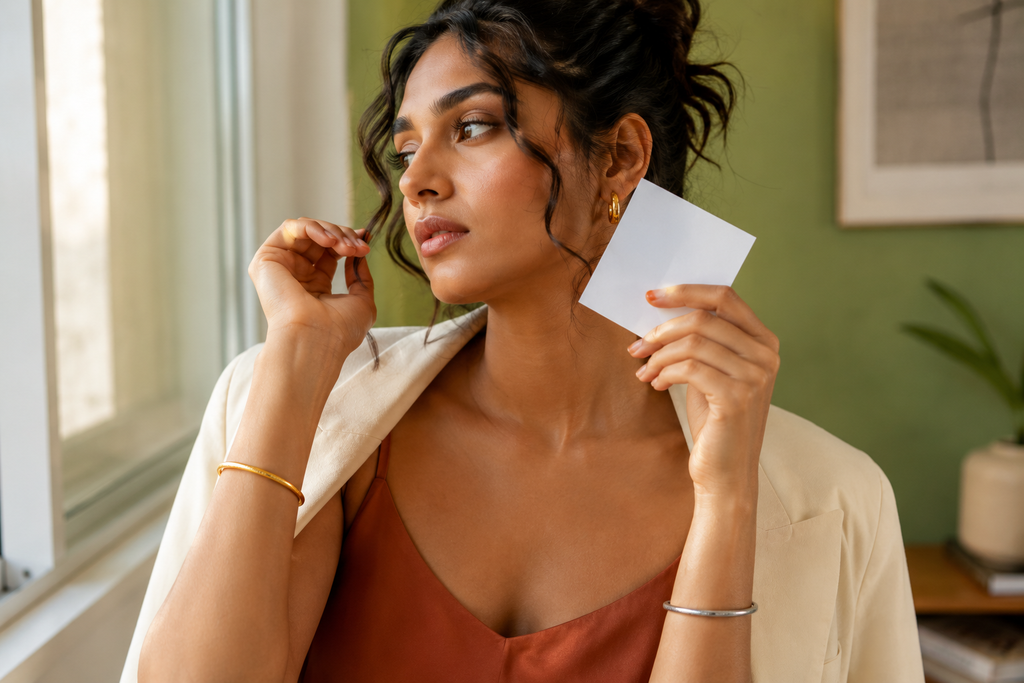
Hold plain white paper beside your face in natural light. Skin that appears golden or yellow may lean warm, while pink or rosy tones can suggest cool. If your skin looks slightly green-grey, muted, or not quite warm or cool, olive may be worth exploring. Nykaa Beauty Book’s undertone guide shares similar at-home methods.
The Colours That Make Your Wardrobe Work Harder
The best colours for Indian skin tone are not about avoiding shades altogether. They are about finding colours that harmonise with your colouring—or contrast with it in a way you love.
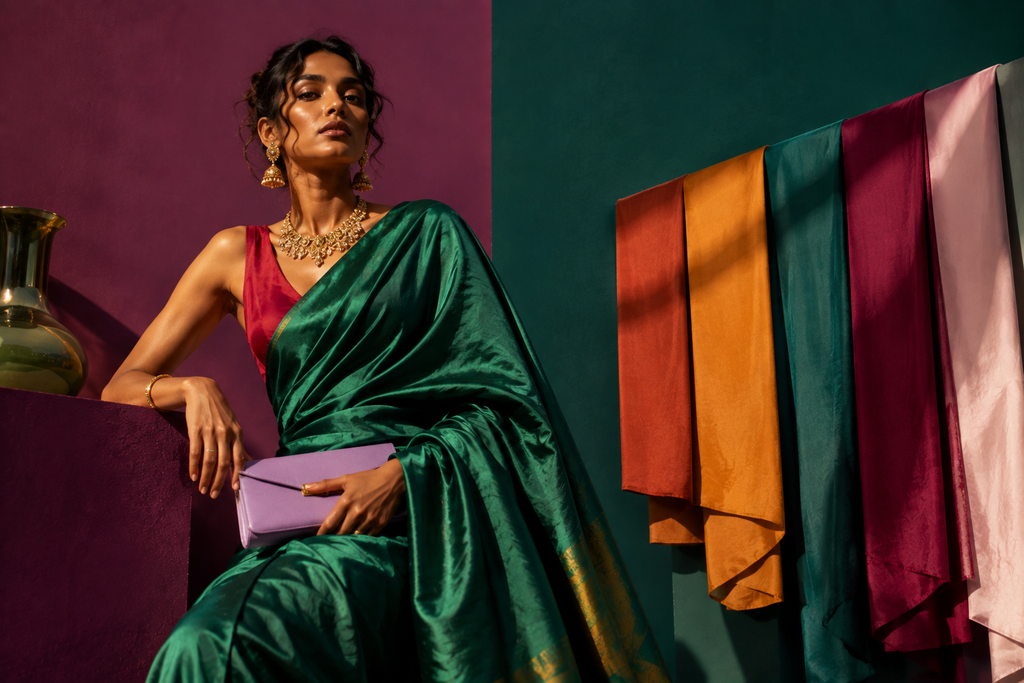
Warm undertones often shine in rust, terracotta, coral, saffron, mustard, warm olive, camel, cream, chocolate, and gold. Try a rust linen co-ord, mustard kurta, coral shirt, or cream saree with a gold border.
Cool undertones often suit emerald, royal blue, ruby, wine, magenta, berry, lavender, charcoal, navy, cool white, and silver. A ruby lehenga, emerald saree, plum kurta, navy shirt, or lavender knit can all be strong options.
Neutral undertones can often borrow from both palettes. Jade, dusty pink, teal, soft white, muted red, denim blue, and balanced beige are especially versatile.
Olive undertones often work beautifully with shades that have depth or softness: sage, dusty rose, mauve, plum, muted mustard, khaki, warm charcoal, and deep teal. If bright orange or stark white feels overwhelming, try terracotta and off-white instead.
For dusky and deep Indian skin tones, do not default to “safe” dark colours. Jewel tones, rich earth tones, bright pastels, and monochrome looks can all be striking. Contrast and saturation usually matter more than complexion labels.
Compare the Look Before You Buy
Understanding proportion and undertone helps, but seeing an outfit on yourself is more useful. A lavender oversized crop top might feel perfect on one person and too washed out or voluminous on another—not because either body is wrong, but because colour, length, styling, and personal preference all interact.
Fashually’s virtual try-on clothes can help you compare outfit ideas, colours, and silhouettes before committing to a purchase. Try high-waisted wide-leg trousers against a straight fit, compare rust with royal blue near your face, or see whether a cropped jacket gives you the proportion you want with a saree, dress, or co-ord set.
Use it as a visual comparison tool, not a fit guarantee. AI virtual try-on cannot confirm exact sizing, fabric drape, comfort, texture, garment quality, or real-world colour accuracy. Always check measurements and size charts before ordering; our guide on how to choose the right clothing size online can help.
Your No-Stylist Shopping Checklist
- What proportion do I want today: longer legs, more waist definition, a relaxed shape, or stronger shoulders?
- Does the silhouette feel balanced—or intentionally dramatic in a way I genuinely like?
- Which two or three colour families make my face look most awake?
- Can I compare this outfit with another colour or fit first?
- Have I checked the fabric composition, garment measurements, and return details?
Frequently Asked Questions
Do I need to know my body shape to dress well?
No. Understanding proportions, preferred silhouettes, and where you like visual attention is usually more useful than choosing a body-shape label.
Can I wear colours outside my undertone palette?
Absolutely. If you love a colour that feels intense near your face, try wearing it as trousers, shoes, a bag, or jewellery instead.
Can Indian skin tones have cool undertones?
Yes. Undertone is not determined by complexion depth, ethnicity, or labels such as fair, wheatish, dusky, or deep.
Does virtual try-on tell me whether an item will fit?
No. It can help compare colour and silhouette, but it cannot guarantee sizing, fabric behaviour, comfort, or exact garment details.
Personal style is not about following a set of rules. It is about understanding why a silhouette or shade works for you, then using that knowledge however you want. Experiment, compare, and keep the looks that feel most like you.