Table Of Content
- Why the Same Size Can Mean Two Completely Different Fits
- Urbanic and Westside Charts: The Details That Matter More Than Your Usual Size
- Read the chart like a stylist, not a gambler
- How to Check Proportions Before You Buy
- Fitted, Oversized or Wide-Leg? Start With the Silhouette
- Virtual Try-On for Online Clothes: A Better Check Before Checkout
- A Pre-Purchase Routine That Cuts Down Guesswork
- FAQs: Making Sense of Online Clothing Sizes
- Why does the same size fit differently across brands?
- Should I size up when buying from Urbanic?
- Can virtual try-on tell me my exact clothing size?
- How can I tell whether wide-leg trousers will work for me?
- What should I check before returning an online fashion order?
You order an M from Urbanic for a college fest, expecting the Pinterest-girl fit from the product photos. It arrives with pinching armholes, a waist that sits too high and trousers that somehow feel both too long and too tight. Or you buy your usual Westside size, only to find that a Nuon M and an Utsa M might as well belong to different wardrobes.
That is why a virtual try-on for online clothes can be useful—but not because it can magically tell you to buy a size 28. The real problem is that S, M and L are not universal measurements. Better online shopping comes down to understanding proportion, fabric, fit blocks and silhouette, then using visual tools to see whether the overall look feels right.
Why the Same Size Can Mean Two Completely Different Fits
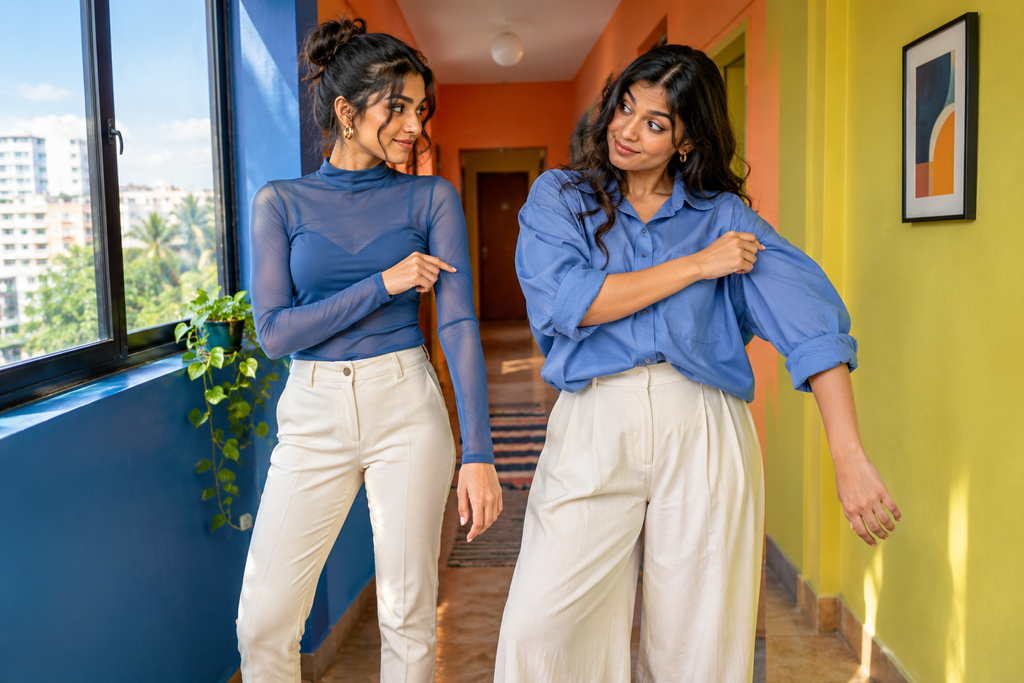
A size label is shorthand, not a promise. Every retailer develops garments around its own fit block: the base pattern used to set bust, waist, hip, shoulder and length proportions. Two brands can call a garment Medium while working from entirely different measurements and design intentions.
That is the heart of fast-fashion sizing inconsistency. One top may be cut with negative ease—a close fit designed to stretch around the body—while another has extra room for movement or layering. In garment construction, ease is simply the difference between your body measurement and the finished garment measurement.
Urbanic’s globally sourced fast-fashion model can mean product-to-product variation influenced by different factories and international sizing conventions. Westside also houses labels with distinct cuts and customer profiles:
- Nuon tends towards closer, trend-led Gen Z silhouettes.
- L.O.V generally leans relaxed and smart-casual.
- Utsa and Bombay Paisley often allow more ease for fusion and ethnic styles.
- Gia is patterned for plus-size curves, with different bust-to-waist and hip proportions.
The same size fitting differently is not a personal failure; it is how retail sizing works. As The Guardian’s look at high-street sizing notes, there is no single consistent standard across brands.
Urbanic and Westside Charts: The Details That Matter More Than Your Usual Size
If you have searched “why Urbanic clothes fit small,” the more useful answer is that some pieces can feel smaller or simply different because the cut, fabric and sourcing vary by product. A fitted mesh top, rigid-denim mini skirt and oversized cotton shirt should never be approached with the same saved size.
For an Urbanic sizing guide, start with the individual product chart. Check garment length, shoulder width and fabric stretch. A 98% cotton, 2% elastane trouser has some give; rigid denim may not. A fitted, non-stretch silhouette requires more precision than a relaxed rayon-blend shirt.
The same logic applies to Westside. A Nuon size guide may not map neatly onto a L.O.V Westside chart because the intended silhouette can differ before fabric even enters the equation. Your Utsa Medium is useful reference data, but it is not a universal passport to every Westside label.
Read the chart like a stylist, not a gambler
- Body measurements: Know your bust, waist, hips and inseam.
- Garment measurements: Pay attention to length, shoulder width and waist circumference.
- Fit description: Fitted, regular, relaxed and oversized are not interchangeable.
- Fabric composition: Stretch, structure and drape matter as much as the numbers.
- Model details: Use the model’s height, measurements and size worn as context—not proof of how it will fit you.
If a model is 5’9″ in a size S and you are 5’2″, a cropped shirt may land like a regular top on you. That is not necessarily a bad outcome; it is simply a different proportion outcome.
How to Check Proportions Before You Buy
Knowing how to read an online clothing size chart in India is only step one. The next question is where the garment will sit on your frame.
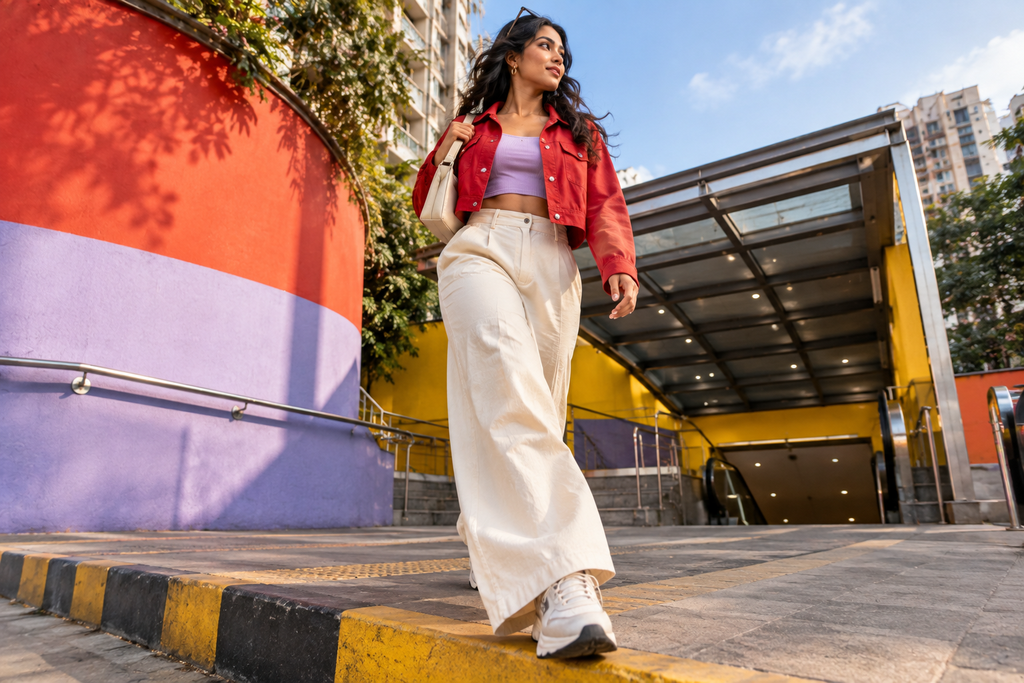
- Shoulder width: A seam that lands beyond your natural shoulder creates a dropped, oversized effect. One that sits inward can restrict movement.
- Armhole depth and sleeves: Deep armholes and long sleeves can make an oversized shirt look intentional—or overwhelm your frame if the volume is uncontrolled.
- Waist placement: On dresses, corset tops and co-ords, check where the garment narrows. A waist designed for a shorter torso can sit awkwardly high on a longer one.
- Trouser rise and leg width: High-rise trousers sit above the navel, while mid-rise styles sit nearer the hips. That changes comfort and visual leg length.
- Garment length: Hem placement decides whether a top reads as cropped, balanced or unexpectedly short—and whether wide-leg trousers skim your shoes or pool on the floor.
Product photography is not always reliable evidence. Pinned backs, hands in pockets, walking shots and low camera angles can make clothes look more tailored or longer than they are. Look for a straight-on standing image, then zoom in on hems, crotch depth and fabric folds. Our guide to building balanced outfit proportions can help you spot these details faster.
Fitted, Oversized or Wide-Leg? Start With the Silhouette
“Will wide-leg trousers suit my body?” is usually the wrong question. Wide-leg trousers are not reserved for one body type; they are about balance, rise, length and styling.
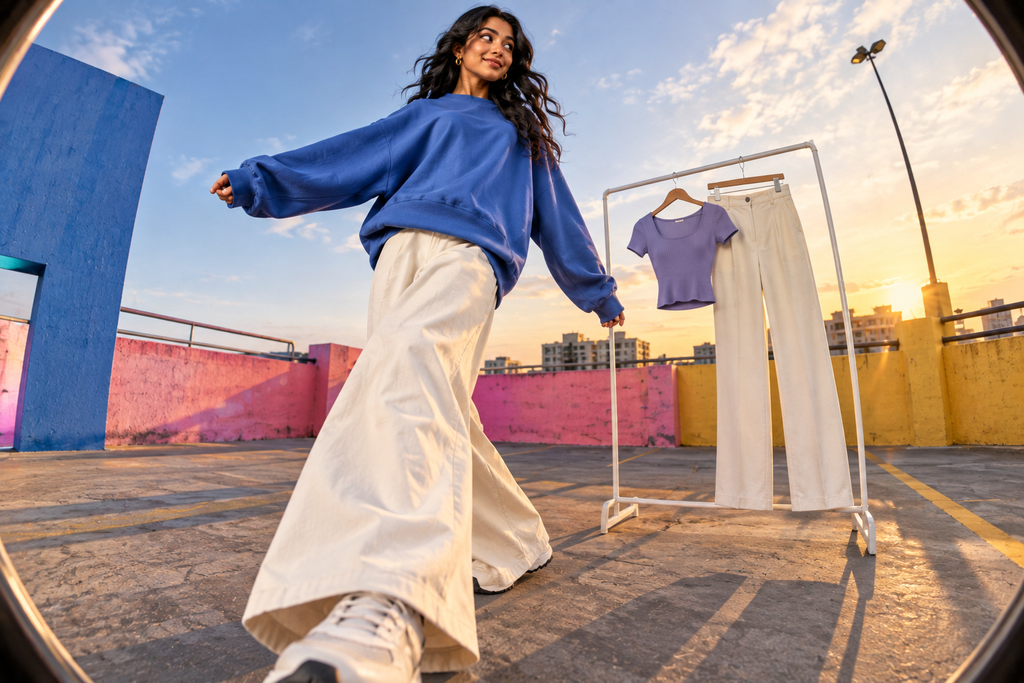
A high-waisted, fluid pair can create a long vertical line. A stiff, ultra-wide pair may add more volume through the lower half. The difference lies in fabric drape, leg width and where the waistband lands. A closer-fitting top is one way to balance a voluminous trouser, but it is not a rule. An oversized shirt can work beautifully too when the shoulder seams, hem and sleeve volume feel intentional.
The same goes for oversized tees. Ideally, they should not be fitted tees bought three sizes up. Look for deliberately dropped shoulders, a wider body, longer sleeves and a hem that still gives the outfit shape. When comparing options, focus on cropped versus regular hems, set-in versus dropped shoulders, straight versus wide legs, and rigid denim versus softer fabrics. For more help, see our guide on comparing fitted and oversized outfits.
Virtual Try-On for Online Clothes: A Better Check Before Checkout
Measurements can tell you whether a garment might physically fit. They cannot answer the equally important question: Will I actually like this silhouette on me?
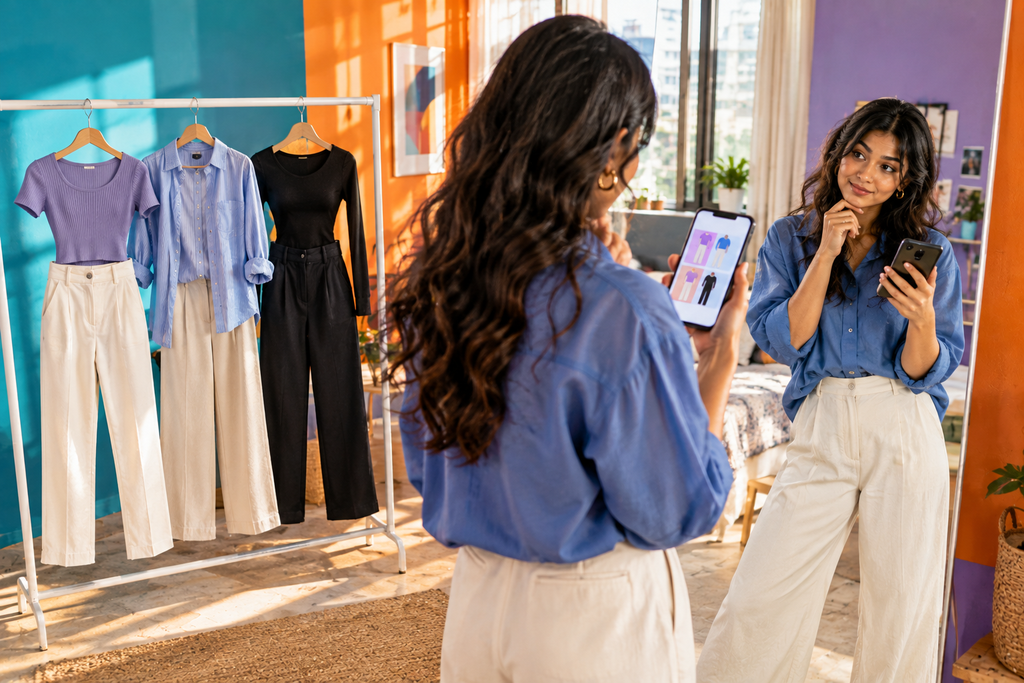
That is where Fashually’s AI Virtual Try-On works as a visual testing layer. Upload a photo and use it as an outfit sandbox to compare different references, colours and proportions on your frame. You might test an oversized Urbanic graphic tee against a fitted option, a cropped top against a regular-length alternative, or straight-leg trousers beside a wide-leg silhouette.
This kind of virtual styling is particularly useful when a product page is visually vague. It gives you a visual draft before you spend money—or order two sizes and prepare for a return. You can learn how Fashually virtual styling works before trying it.
There is an important limitation: virtual styling cannot measure your waist to the millimetre, replicate scratchy fabric, confirm garment quality or guarantee real-world fit. Use it to assess visual balance, not as a replacement for the brand’s size chart.
A Pre-Purchase Routine That Cuts Down Guesswork
- Identify the intended fit: body-hugging, regular, relaxed or oversized.
- Take current measurements of your bust, waist, hips, shoulder width and inseam.
- Read the chart for that exact product rather than relying on a previous Urbanic or Westside purchase.
- Check fabric and stretch. Rigid denim, polyester satin and stretchy jersey behave very differently.
- Compare your proportions with the model information and every available product image.
- Run a visual proportion check with a virtual try-on if you are deciding between silhouettes.
- Confirm the return policy, keep tags attached and note the return window.
Returns are frustrating and expensive for shoppers and brands alike. McKinsey’s research on returns highlights why better expectation-setting matters.
The goal is not to eliminate every return. Clothing is tactile, personal and unpredictable. But if you treat size labels as one data point—alongside garment details, fabric and a visual proportion check—your Urbanic or Westside order has a much better chance of looking like the outfit you saved in the first place.
FAQs: Making Sense of Online Clothing Sizes
Why does the same size fit differently across brands?
Brands use different fit blocks, garment measurements, fabrics and intended silhouettes. A Medium in one brand may be cut for a close fit, while another Medium may include extra room for layering.
Should I size up when buying from Urbanic?
Do not automatically size up. Check the chart for the specific product, its fabric stretch and intended fit. A relaxed shirt and a fitted rigid-denim skirt may require completely different choices.
Can virtual try-on tell me my exact clothing size?
No. A virtual try-on for online clothes can help you compare silhouettes and proportions, but it cannot guarantee physical fit or replace your measurements and the product size chart.
How can I tell whether wide-leg trousers will work for me?
Check the rise, waist placement, leg width, inseam and fabric drape. Then consider the top and shoes you plan to wear with them, since those details shape the overall balance.
What should I check before returning an online fashion order?
Review the retailer’s return window, keep tags attached and try the item on indoors before removing packaging or making alterations.